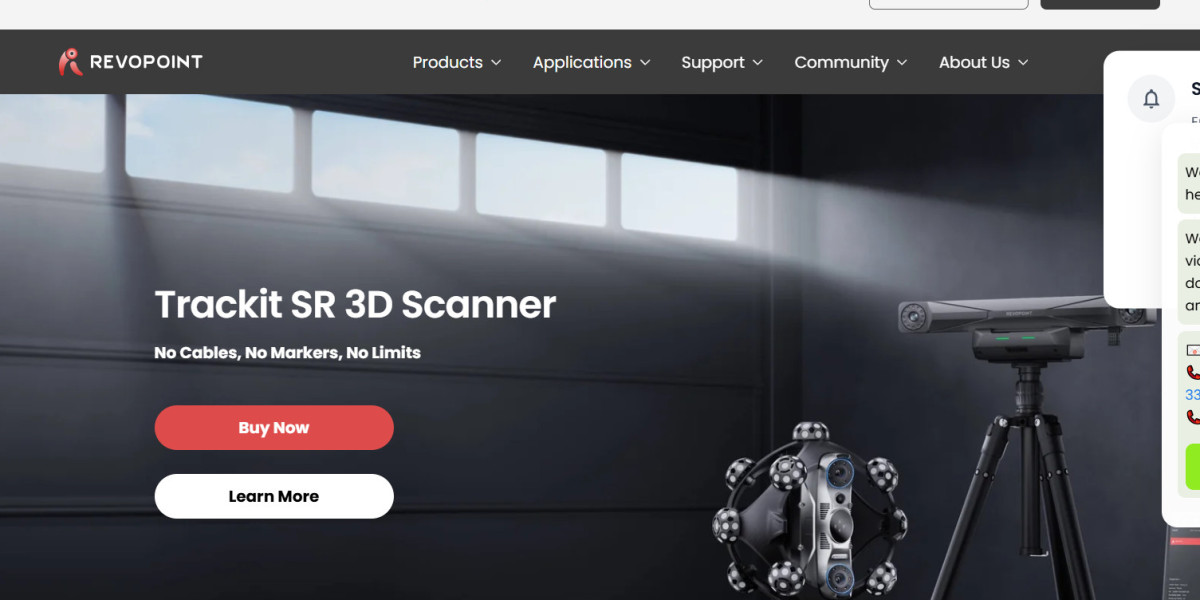

Reverse engineering plays an important role in modern manufacturing, product development, and engineering design. It allows professionals to study an existing physical object and recreate its geometry as Automotive 3d scannerdigital model. With a 3D scanner for printing and reverse engineering from Revopoint 3D, users can capture physical shapes and transform them into digital data for further analysis, modification, and production. This technology offers practical advantages for businesses, designers, engineers, and hobbyists who want to improve their digital workflows.
One major benefit of 3D scanning is the ability to capture complex shapes more efficiently than traditional manual measurement alone. Many physical objects contain curved surfaces, irregular contours, and intricate details that can be difficult to reproduce accurately using basic measuring tools. A suitable 3D scanner records surface geometry and creates a digital representation that users can examine and process. This can provide a valuable starting point for recreating objects in computer-aided design software.
Revopoint 3D develops scanning solutions for different applications, making it possible for users to explore digital reconstruction according to their specific requirements. Depending on the model, a scanner may be suitable for small mechanical components, consumer products, artistic objects, or larger physical items. Selecting the appropriate device requires evaluating factors such as scanning accuracy, object dimensions, surface characteristics, portability, and software support.
In manufacturing environments, reverse engineering can help solve problems involving obsolete or unavailable components. A machine may require a replacement part even when the original technical drawings are missing. Instead of designing the component entirely from scratch, an engineer can scan the existing part and use the resulting data to reconstruct its geometry. The digital model can then be adjusted to meet manufacturing requirements, provided that important dimensions and functional features are independently verified.
The same process can support product improvement. Designers may scan an existing product to understand its shape before developing a revised version. They can explore changes to the external appearance, improve ergonomic features, or adapt the design for a different manufacturing method. When combined with 3D printing, this approach enables rapid prototyping and allows several design variations to be tested before a final version is produced.
Another advantage is the potential to reduce development time. Manual modeling of complicated objects can require extensive measurement and repeated adjustments. Scanning provides a digital reference that may simplify the initial modeling stage. However, the overall time saved depends on the complexity of the object, the quality of the scan, and the amount of processing needed afterward. Users must still inspect the data and correct any errors that could affect the final result.
For successful reverse engineering, scan preparation is essential. Reflective, transparent, or very dark surfaces can present challenges for some scanning technologies. Depending on the object and scanner, surface preparation, additional scanning angles, or specialized settings may be necessary. Multiple scans may also need to be aligned and merged to capture areas that are difficult to reach from one direction.
Once the model is processed, it can support different workflows, including 3D printing, product visualization, digital archiving, and further engineering analysis. The final output should be checked for missing geometry, unwanted noise, and dimensional accuracy before being used for manufacturing.
In conclusion, Revopoint 3D scanners offer a useful starting point for reverse engineering and digital product development. By capturing physical geometry and making it available for digital processing, these tools can help users recreate existing components, explore design improvements, and prepare models for 3D printing. With appropriate equipment, software, and quality-control procedures, 3D scanning can become a valuable part of an efficient engineering workflow.