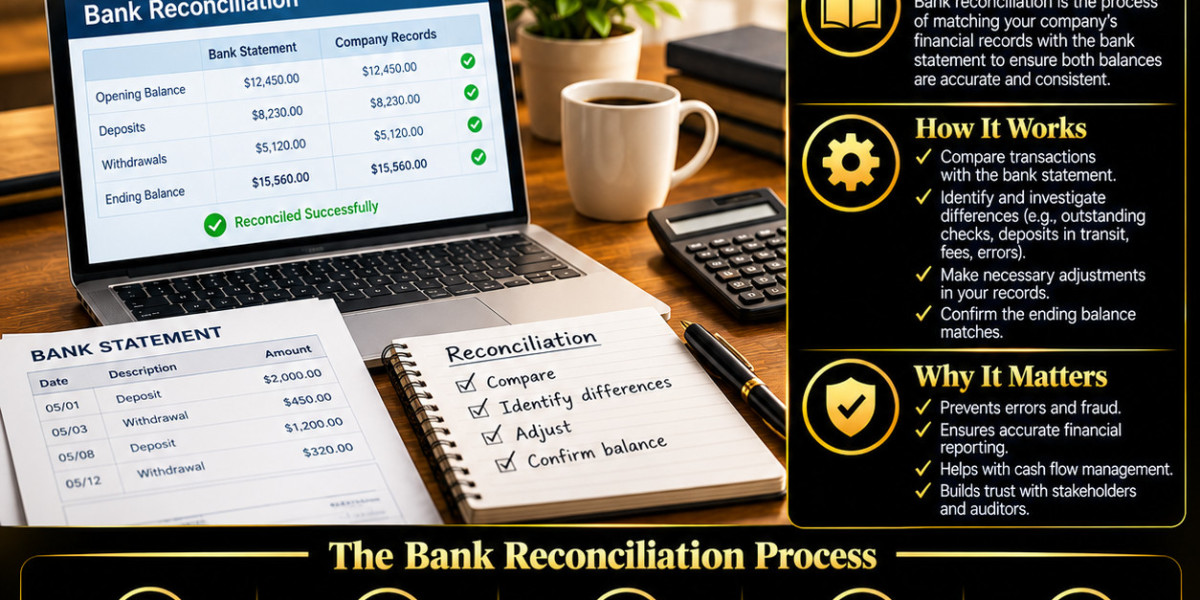

Maintaining business finances is not just about making note of sales and purchases. It's also important for businesses to ensure their books match what their bank reports. This is why bank reconciliation is an important accounting process. A regular bank reconciliation aids in detecting discrepancies between a company's accounting records and its bank statement.
So, what is bank reconciliation? It's the process of checking the balance and transactions in a company's books against the ones reflected on its bank statement, in simple terms. If the balances are not equal, the business can find out how much they differ and then investigate what caused the discrepancy (was it a timing problem, an accounting error or any other problem).
The reconciliation meaning in accounting generally refers to comparing two sets of financial information to make sure they are accurate and consistent. Reconciliation accounting is used specifically for business bank accounts as bank reconciliation accounting.
How to Reconcile a Bank Statement
Understanding how to balance a bank statement can be helpful to accounting staff and business owners. It typically begins with the bank statement and a cross-check of the company's books over the same time frame.
Compare deposits and other incoming transactions (as recorded in the accounting system) to that displayed by the bank. Then compare withdrawals, checks, electronic payments, bank fees and more. If any transaction is present in one of the records but not the other, it should be investigated.
It is normal for some of the differences to occur. In some cases, a business could book a check that hasn't yet been deposited at the bank. Likewise, a deposit at the end of a reporting period could not show up on the bank statement until a later time. Here are some examples of timing differences.
If there are other differences, it might be a mistake. A transaction may have been made for the incorrect amount or may not have been made at all. One of the important advantages of bank reconciliation is its ability to identify these problems.
For example, if a company's accounting records indicate a higher balance than what is listed on its bank statement, it could be because several checks have yet to clear. Once these outstanding checks are deducted and any bank fees or deposits in transit are added, the two totals can be made equal.
Bank Reconciliation Statement and Its Importance
A bank reconciliation statement shows the adjustments required to reconcile the company's books and bank. Performing bank reconciliation in an accurate way can enable businesses to identify errors, unusual transactions and ensure financial records are accurate.
Bank reconciliation is a subset of an account reconciliation and deals only with bank-related transactions. The two processes are helpful for maintaining accurate accounting information.
Frequent bank reconciliation can also help with managing cash flow. Business owners should have access to clear transactions and outstanding payments, so they can make informed decisions on cash available.
For companies that deal in a lot of transactions, you can reconcile the bank statements every month or more often if necessary. Maintaining a well-documented and timely accounting review of the discrepancies can ease the process and prevent accounting discrepancies from going unresolved.
In general, bank reconciliation is an easy yet crucial accounting process. Businesses can compare bank statements to their internal records to keep financial information more accurate and understand their actual cash position.
For more details visit us - https://accountance.net/