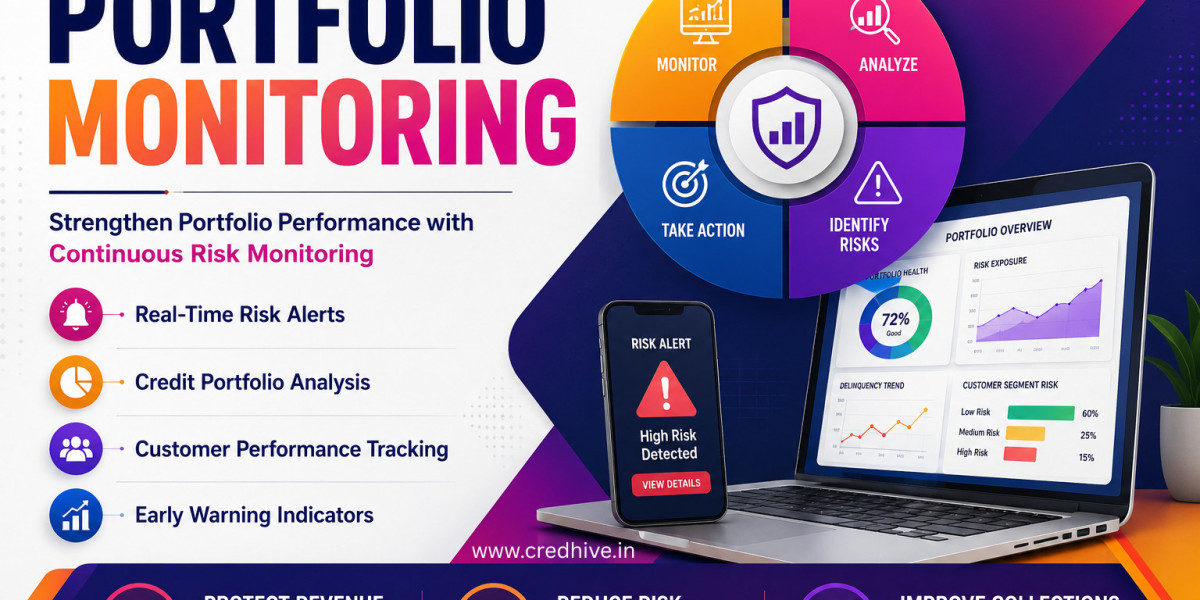

Portfolio Monitoring is the ongoing process of reviewing the financial performance, repayment behavior, risk indicators, and other relevant developments across a portfolio of borrowers, customers, investments, or counterparties.
For banks, NBFCs, fintech lenders, and other financial institutions, monitoring does not end after a loan is approved and disbursed. A borrower's financial condition can change because of declining sales, increased debt, delayed payments, legal developments, changes in ownership, or broader industry conditions.
A structured portfolio monitoring process helps lenders identify these changes early and determine whether additional review or action is required.
Why Is Portfolio Monitoring Important?
Credit underwriting provides an assessment at a particular point in time. Portfolio monitoring provides a way to determine whether that assessment remains appropriate as circumstances change.
Effective monitoring can help financial institutions:
- Identify early signs of borrower stress
- Track repayment and financial performance
- Detect changes in credit risk
- Monitor concentration across sectors or customer groups
- Prioritize accounts requiring additional review
- Support proactive risk management
- Improve portfolio-level decision-making
The objective is not to generate as many alerts as possible. Excessive alerts can overwhelm risk teams and make important signals harder to identify. The focus should instead be on relevant, timely, and actionable information.
Key Areas of Portfolio Monitoring
1. Financial Performance
Financial indicators can provide insight into changes in a borrower's ability to meet obligations.
Depending on the portfolio and available information, lenders may monitor revenue trends, profitability, leverage, liquidity, working capital, debt levels, and other relevant financial indicators.
For example, a consistent decline in revenue combined with increasing borrowing may warrant closer examination than either indicator considered independently.
2. Repayment and Credit Behavior
Payment behavior is an important part of ongoing credit risk monitoring.
Lenders can track missed payments, overdue amounts, changes in repayment patterns, utilization of available credit, restructuring activity, and other relevant indicators.
A temporary delay does not necessarily mean that a borrower has become financially distressed. Monitoring helps identify patterns that may justify further investigation.
3. External Risk Signals
Information outside the lender's own systems can provide additional context.
Relevant signals may include changes in business status, ownership, significant legal developments, regulatory events, adverse business information, or changes affecting the borrower's industry.
Combining internal and external information can provide a broader view of borrower risk.
4. Portfolio Concentration
Risk can also arise from concentration.
A lender may have a large proportion of exposure to one industry, geography, customer segment, business group, or type of borrower. Even if individual accounts appear healthy, excessive concentration can increase portfolio vulnerability when a common external event affects that segment.
Portfolio monitoring therefore needs to look beyond individual borrowers and assess the portfolio as a whole.
How Does Portfolio Monitoring Work?
A typical process can include:
Data collection → Risk segmentation → Indicator analysis → Alert generation → Investigation → Action → Ongoing review
First, relevant borrower and portfolio data is collected. Accounts can then be segmented based on factors such as product type, exposure, risk category, industry, or repayment behavior.
Risk indicators and predefined thresholds are applied to identify accounts that may require attention. Analysts then investigate the underlying information before determining an appropriate response.
Possible actions may include requesting updated financial information, increasing monitoring frequency, reviewing exposure, contacting the borrower, or escalating the account according to internal policies.
Role of Early Warning Signals
Early warning signals for credit risk can help lenders identify changes before they become more significant problems.
Examples may include:
- Increasing payment delays
- Declining financial performance
- Rising leverage
- Reduced business activity
- Significant management or ownership changes
- Deteriorating industry conditions
- New legal or regulatory developments
- Unusual transaction patterns
The interpretation of these signals is important. An alert should prompt investigation rather than automatically classify a borrower as a default risk.
Technology and Portfolio Monitoring
Managing thousands of borrowers manually can make continuous monitoring difficult. A portfolio monitoring platform can bring borrower data, risk indicators, alerts, dashboards, and workflows into a centralized environment.
Technology can help institutions:
- Automate data collection
- Apply monitoring rules
- Generate risk alerts
- Segment portfolios
- Track investigation status
- Create management reports
- Maintain an audit trail
Data integration can also help risk teams compare information from multiple sources. For example, internal repayment behavior can be reviewed alongside changes in business information or external risk indicators.
Automation improves efficiency, but experienced analysts remain important for interpreting unusual cases and deciding what action is appropriate.
Practical Example
Consider an NBFC with a portfolio of 2,000 SME borrowers.
During quarterly monitoring, the institution identifies a group of borrowers in the same industry with declining revenue and increasing payment delays. Separately, industry-level information indicates that the sector is experiencing weaker demand.
Rather than treating every borrower identically, the NBFC could segment the affected accounts based on exposure, repayment history, financial strength, and other indicators.
Higher-risk cases could receive additional review, while lower-risk borrowers could remain under standard monitoring.
This approach allows the lender to focus resources where they are most relevant.
Best Practices for Effective Portfolio Monitoring
Establish Relevant Monitoring Indicators
Indicators should reflect the risks associated with each lending product and borrower segment.
Use Risk-Based Segmentation
High-exposure or higher-risk accounts may require more frequent monitoring than low-risk accounts.
Combine Internal and External Data
Internal repayment data becomes more useful when viewed alongside relevant external business and market information.
Calibrate Alert Thresholds
Thresholds should be reviewed periodically. Too many alerts can create operational fatigue, while overly broad thresholds may cause important developments to be missed.
Define Clear Escalation Procedures
Risk teams should know who investigates an alert, what information should be reviewed, and when an issue needs to be escalated.
Continue Monitoring After Remediation
Once an account has been reviewed, monitoring should continue to determine whether the underlying issue has improved or developed further.
Portfolio Monitoring vs. Credit Underwriting
Credit underwriting primarily evaluates whether a borrower should receive credit and under what terms. Portfolio Monitoring focuses on what happens after the relationship or exposure has been established.
The two functions should work together. Information identified during monitoring can inform future underwriting decisions, while underwriting risk assessments can determine which indicators deserve greater attention during portfolio monitoring.
Conclusion
Portfolio Monitoring is an important part of modern credit risk management. By continuously reviewing financial performance, repayment behavior, external developments, and portfolio concentration, financial institutions can identify changes that may require attention.
For banks, NBFCs, and fintech lenders, the most effective approach combines reliable data, meaningful early warning indicators, risk-based segmentation, technology-enabled workflows, and human analysis. The goal is not simply to watch the portfolio but to turn relevant information into timely and informed risk-management actions.
FAQs
What is Portfolio Monitoring?
Portfolio Monitoring is the ongoing review of borrowers, exposures, repayment behavior, financial indicators, and other risk factors to identify changes that may affect a financial portfolio.
Why is Portfolio Monitoring important for banks and NBFCs?
It helps financial institutions identify potential borrower stress, monitor portfolio concentration, track changing risk conditions, and prioritize accounts requiring further review.
What are common early warning signals in credit portfolios?
Common indicators include increasing payment delays, declining financial performance, higher leverage, reduced business activity, ownership changes, legal developments, and adverse industry conditions.
How does technology improve Portfolio Monitoring?
Technology can automate data collection, risk rules, alerts, portfolio segmentation, reporting, and investigation workflows, helping risk teams manage larger portfolios more efficiently.
Is Portfolio Monitoring performed only after a loan is disbursed?
It is primarily associated with ongoing exposure management after origination, but monitoring principles can also apply across other financial relationships and can feed information back into future underwriting and risk decisions.