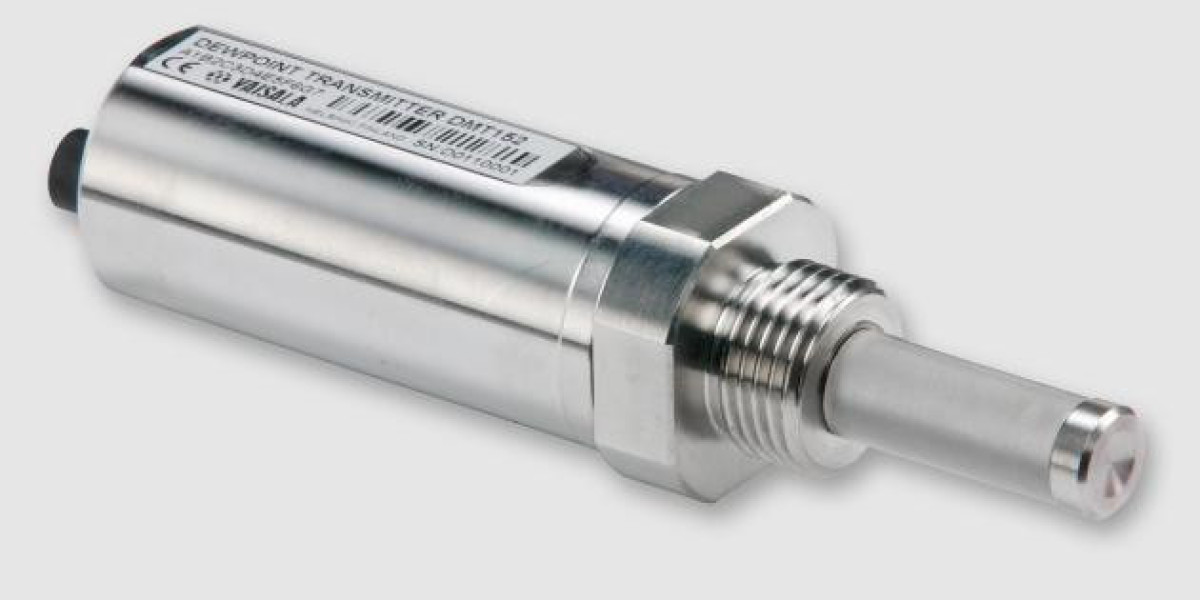

Moisture levels can have a major impact on industrial equipment, production quality, and system efficiency. In compressed air and gas applications, excessive moisture may cause corrosion, contamination, and equipment failure. A Dewpoint transmitter provides reliable moisture measurements and sends this information to a control or monitoring system for continuous process management.
What Is a Dewpoint Transmitter?
A dewpoint transmitter is an industrial measuring device designed to measure the dew point temperature of air or gas. It uses a moisture-sensitive sensor to detect water vapor and converts the measurement into an electrical output that can be monitored by connected control systems.
Unlike a handheld instrument, a transmitter is generally designed for fixed installation, making it suitable for continuous monitoring in industrial environments.
How Does It Work?
The transmitter detects changes in moisture within the measured gas and calculates the corresponding dew point temperature. The measurement is then communicated through a compatible output signal or communication interface.
This allows operators to monitor moisture conditions in real time and respond quickly when readings move outside the required operating range.
Industrial Applications
A Dewpoint transmitter is widely used in compressed air systems, industrial gas production, manufacturing facilities, and process industries. It can be installed near air dryers, pipelines, storage systems, and other critical measurement points.
Monitoring dew point helps technicians evaluate dryer performance and detect moisture problems before they affect downstream equipment or production processes.
Benefits of Continuous Dew Point Monitoring
Installing a reliable transmitter provides several practical advantages:
Real-time monitoring: Provides ongoing information about moisture conditions.
Early problem detection: Helps identify rising moisture levels quickly.
Equipment protection: Supports efforts to reduce corrosion and condensation.
Process control: Helps maintain moisture conditions within required limits.
Maintenance support: Provides useful data for checking dryer and system performance.
Selecting the Right Transmitter
The appropriate transmitter depends on the specific application. Factors such as measurement range, accuracy, pressure, temperature, response time, sensor technology, and output options should be considered before installation.
For demanding industrial environments, a robust design with stable performance can provide dependable measurements over extended operating periods.
Conclusion
A Dewpoint transmitter is an important solution for continuous moisture monitoring in industrial air and gas systems. By providing accurate dew point data and integrating with monitoring or control equipment, it helps operators maintain process conditions, protect equipment, and respond to moisture-related issues more efficiently. Choosing a transmitter according to the application's technical requirements ensures reliable and consistent performance.