
Tokenization is often described as the process of turning a physical or traditional financial asset into a digital token on a blockchain. However, the more important question is what makes that token actually connected to the asset it represents.
A token stored on a blockchain does not automatically prove that someone owns a building, gold bar, artwork, private credit instrument, or other real-world asset. The connection depends on a combination of legal agreements, asset custody, authoritative ownership records, verification procedures, smart contracts, and ongoing governance.
The Bank for International Settlements (BIS) describes tokenization as transforming claims on traditional assets into tokens on a programmable platform. It also emphasizes that tokenization requires both information about the asset and its ownership, together with rules governing how those tokens can be used and transferred.
Understanding this connection is essential because blockchain can make ownership records transparent and programmable, but it cannot independently verify whether a physical asset exists or whether the person issuing a token actually controls it.
What Creates the Link Between a Token and a Real-World Asset?
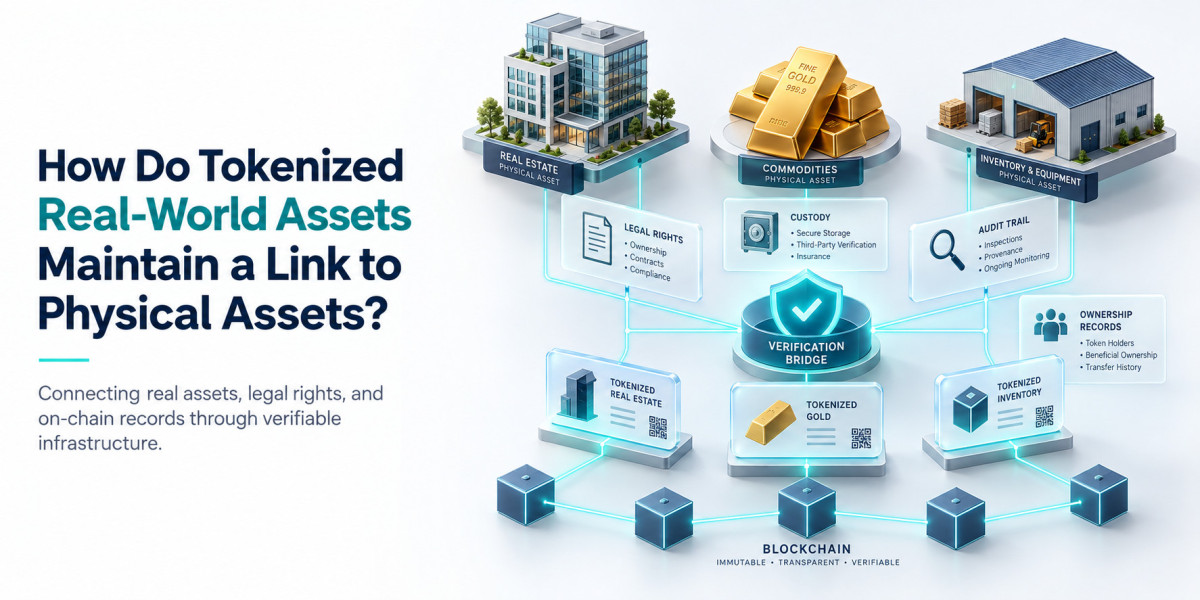
A tokenized asset usually involves two connected layers.
The off-chain layer contains the actual asset and its legal, financial, and physical records. This might include a property deed, warehouse receipt, custody agreement, title document, securities account, appraisal report, or other evidence establishing ownership and control.
The on-chain layer contains the digital token and transaction history. Blockchain records can show who holds tokens, when they were transferred, and what rules apply to those transfers.
The connection between these layers is established through legal and operational arrangements. BIS research notes that tokenization requires the rules surrounding tokenized assets to align with the rules governing their real-world counterparts.
For example, suppose a company owns a commercial building and creates 100,000 tokens representing economic interests in that property. The blockchain can record the 100,000 tokens, but the building remains registered through the applicable property and legal system. The tokenization structure must therefore specify what rights each token represents and how those rights relate to the underlying property.
This is why tokenization should not be viewed simply as putting an asset's name onto a blockchain. It is an asset-to-right-to-token structure.
How Blockchain-Based RWA Tokenization Establishes Asset Ownership
Blockchain-Based RWA Tokenization generally begins with identifying the asset and establishing who legally owns or controls it.
The issuer then determines what legal interest will be represented by the token. Depending on the structure, the token might represent direct ownership, an interest in a legal entity that owns the asset, a claim against an issuer, a security entitlement, or another contractual right.
A dedicated Real-World Asset Tokenization Platform can then connect the legal structure with token issuance, investor onboarding, wallets, compliance controls, distributions, and transfer records.
This distinction matters because two tokens can reference the same type of asset while providing completely different rights. A token linked to a property-owning company, for example, may give investors economic rights in that company rather than direct title to the property.
The U.S. Securities and Exchange Commission's January 2026 statement on tokenized securities similarly distinguishes different tokenization models. It explains that some issuer-sponsored structures integrate blockchain ownership records with the issuer's authoritative records, while other structures use tokens to represent security entitlements held through custody arrangements.
Therefore, investors need to understand what the token legally represents, not merely what asset appears in its marketing materials.
The Role of Custody and Asset Segregation
Custody is one of the most important mechanisms for maintaining the connection between a token and its underlying asset.
For physical assets such as gold, the underlying asset may be stored in a regulated or professionally managed vault. For real estate, ownership may be held through a company or legal vehicle. For securities, assets may remain with a qualified custodian or financial institution.
The token issuer should maintain clear records showing which assets support the outstanding tokens. Asset segregation can also help prevent the underlying property or financial assets from being improperly mixed with an issuer's operating assets.
Consider tokenized gold. If an issuer claims that every token corresponds to a specific quantity of gold, there must be a custody arrangement establishing where the gold is held and who controls it. Independent verification or audits can provide additional evidence that the quantity of gold corresponds to the number of tokens in circulation.
Recent regulatory discussions around tokenized gold in the UK illustrate why custody and regulatory treatment remain important as tokenization expands.
The same principle applies to real estate. Blockchain can show token balances, but it cannot physically verify whether a building exists, whether it has been sold, or whether a mortgage has been placed against it. Those facts require legal records, property databases, professional inspections, and other verification mechanisms.
Smart Contracts Help Preserve the Connection
Smart contracts provide the programmable layer that governs how tokens behave.
They can define rules for issuance, transfers, investor eligibility, distributions, redemptions, and other functions. For regulated assets, smart contracts can also incorporate restrictions such as approved-wallet requirements or transfer limitations.
For example, a tokenized private-credit instrument could be programmed so that eligible investors receive scheduled distributions based on payments from the underlying loan portfolio. A real-estate token could distribute rental income according to the rights established in the legal agreements.
The BIS has highlighted programmable transactions as one of the important characteristics of tokenization because smart contracts can combine asset transfers, payments, and contractual conditions on programmable infrastructure.
However, smart contracts do not independently guarantee that the underlying asset exists. They enforce programmed rules based on the information and instructions supplied to them.
That creates an important distinction:
Blockchain can verify what happened on-chain. It cannot automatically verify every fact that happens off-chain.
This is why tokenization systems often require trusted data sources, custodians, auditors, legal entities, registries, and other external verification mechanisms.
Oracles Connect Blockchain Data With the Physical World
Oracles can provide another important connection between blockchain systems and real-world events.
An oracle can transmit external information to a smart contract. Depending on the application, this information might include property valuations, commodity prices, interest rates, asset performance, payment information, or other verified data.
Imagine a tokenized commercial property where rental income is distributed to token holders. The blockchain may handle the distribution, but information about actual rental receipts originates outside the blockchain. An oracle or other trusted data mechanism can transfer verified information into the tokenization system.
This creates a broader architecture:
Physical asset → legal ownership → verified data → blockchain record → token → investor rights
Each connection needs appropriate controls. If any layer is unreliable, the integrity of the overall tokenization structure can be weakened.
Legal Agreements Are as Important as Blockchain Records
One of the most common misunderstandings about RWA tokenization is assuming that blockchain ownership automatically equals legal ownership.
It does not necessarily work that way.
The legal relationship depends on the jurisdiction, asset type, contractual structure, and applicable regulations. A token may represent direct ownership, an indirect interest, a contractual claim, or another financial right.
The SEC's guidance makes this distinction particularly clear for tokenized securities. The agency explains that tokenized securities can use different structures and that the rights attached to the digital representation may differ depending on how the instrument is designed.
This means token issuers need legal documentation that connects the blockchain representation with enforceable rights.
For example, a real-estate tokenization structure may involve:
- A property-owning legal entity
- Property title documentation
- Investor agreements
- Token issuance terms
- Custody arrangements
- Distribution rules
- Transfer restrictions
- Compliance procedures
- Records of outstanding tokens
The blockchain becomes part of this broader legal and operational framework rather than replacing it.
Verification, Audits, and Proof of Reserves
Continuous verification is particularly important when tokens represent assets that can change in value, ownership, or quantity.
Depending on the asset, verification may involve:
- Independent audits
- Proof-of-reserves reports
- Property inspections
- Custodian statements
- Valuation reports
- Legal title searches
- Financial statements
- On-chain supply monitoring
For example, if an issuer creates one million tokens representing an asset pool, the system should have a reliable mechanism for determining whether the underlying asset pool continues to support those tokens.
This becomes even more important when tokens can be redeemed. If token holders have a contractual right to receive an underlying asset or proceeds from its sale, the issuer needs operational processes capable of fulfilling that obligation.
The Financial Stability Institute has noted that tokenization can improve efficiency, transparency, and fractionalization, but it also creates operational complexity and regulatory challenges that require appropriate governance and risk management.
Real-World Example: Tokenized Real Estate
Real estate illustrates the connection particularly well.
Suppose an apartment building is valued at $10 million. Instead of selling the property to a single buyer, an issuer establishes a legal entity that owns the building. It then creates 100,000 digital tokens representing defined economic interests associated with that structure.
The building remains a physical property. Its title remains subject to the applicable property law. Rent continues to be collected through traditional financial channels.
The blockchain records token ownership and can automate certain investor functions, such as distributions and eligible transfers.
If an investor owns 1,000 tokens, the investor's rights depend on the legal documents governing those tokens. The blockchain proves possession of the digital tokens, while the legal structure determines what those tokens entitle the holder to receive.
BIS research published in 2025 and revised in 2026 examines tokenized real estate and identifies the potential for tokenization to address some of the traditional illiquidity and transaction frictions associated with property markets.
The example demonstrates the central principle: the blockchain represents the rights, while the legal and operational infrastructure connects those rights to the property.
What Happens When the Underlying Asset Changes?
Maintaining the link is not a one-time process.
Suppose a token represents a property and the property is sold. The tokenization system must have a defined process for handling that event. The same applies when a loan is repaid, gold is withdrawn, securities are transferred, or an asset becomes subject to a new lien.
This requires lifecycle management.
A well-designed tokenization system therefore monitors more than token balances. It must also track relevant changes to the underlying asset and determine whether those changes affect token-holder rights.
The BIS has emphasized that tokenization involves technical, legal, and economic challenges because traditional assets operate through existing systems that must interact with digital infrastructure.
Without these processes, an on-chain token could continue circulating even if the circumstances surrounding its underlying asset have changed.
Key Risks That Can Break the Asset-to-Token Link
Tokenization does not eliminate traditional asset risks. Instead, it can introduce new points where the connection can fail.
Custody risk can arise if the entity holding the underlying asset fails to safeguard it.
Legal risk can occur when token-holder rights are unclear or unenforceable.
Valuation risk can emerge when asset values are difficult to determine independently.
Oracle risk exists when incorrect external information enters a blockchain system.
Smart-contract risk can result from coding errors or poorly designed transfer logic.
Issuer risk can occur when the token issuer fails to maintain adequate reserves or comply with contractual obligations.
Regulatory risk may arise when tokenization crosses jurisdictions with different rules.
These risks demonstrate why blockchain transparency should not be confused with complete transparency of the underlying physical asset. A blockchain can provide a highly visible record of token transactions while the physical asset still depends on external institutions and legal systems.
Why the Connection Matters for Investors
The strength of a tokenized RWA structure ultimately depends on more than blockchain technology.
Before evaluating a token, investors and institutions should understand:
- What exactly does the token represent?
- Who legally owns the underlying asset?
- Where is the asset held or registered?
- Who is responsible for custody?
- How are assets independently verified?
- What happens if the issuer fails?
- What rights does a token holder legally possess?
- How are transfers and redemptions handled?
These questions help distinguish a token that represents a legally structured claim from a token that merely references an asset's price.
The SEC has similarly stressed that tokenization does not change the underlying legal nature of a security simply because the instrument is represented on a blockchain.
Conclusion
Tokenized real-world assets maintain their connection to physical and traditional assets through a combination of legal ownership structures, custody, asset verification, authoritative records, smart contracts, trusted data, and continuous governance. Blockchain provides an efficient and transparent record for digital ownership and transactions, but the underlying asset still depends on real-world legal and operational infrastructure. For this reason, successful tokenization requires coordination between technology, finance, compliance, custody, and law. Blockchain App Factory provides best services for businesses exploring RWA tokenization, including the development of solutions designed to connect real-world assets with secure digital ownership and blockchain-based infrastructure.
FAQs
1. Does owning an RWA token mean owning the physical asset?
Not necessarily. The token may represent direct ownership, an indirect interest, or a contractual claim. Its legal rights depend on the tokenization structure and applicable law.
2. How is a token linked to real estate?
A legal entity or contractual structure can connect the token to the property. Blockchain records token ownership, while property and legal records establish ownership of the underlying real estate.
3. Can blockchain verify that a physical asset exists?
Blockchain can verify information recorded on-chain, but it cannot independently inspect a physical asset. Custodians, auditors, inspections, registries, and trusted data providers may be required.
4. What role do smart contracts play in RWA tokenization?
Smart contracts can automate token issuance, transfers, compliance rules, distributions, and other functions according to predefined conditions.