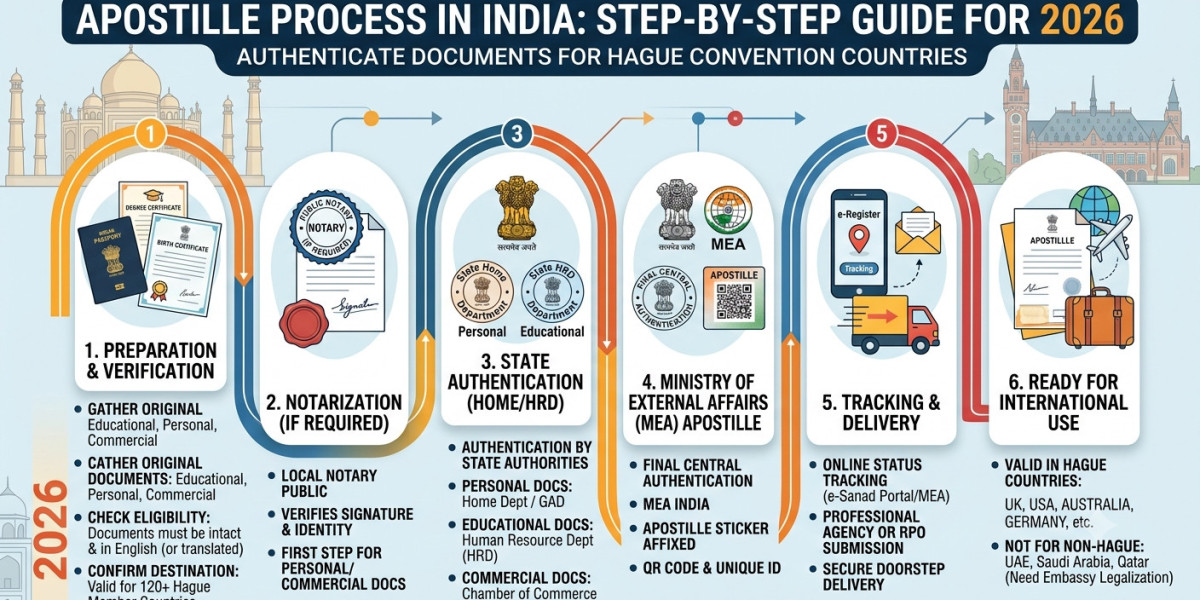

Apostille Process in India: Step-by-Step Guide for 2026
If you need to use an Indian document in another country, understanding the apostille procedure is important. Apostille services in Hyderabad can help individuals and businesses complete the required authentication process and prepare documents for international use. Secure Apostille Services assists customers with the documentation, verification, authentication, and apostille stages while helping them understand the requirements for different types of documents.
What Is an Apostille?
An apostille is a certificate or authentication attached to a public document so that the document can be recognized in another country that is part of the Hague Apostille Convention.
The apostille confirms the authenticity of the signature, seal, or stamp on the document. It does not generally certify the contents of the document itself.
Common documents that may require an apostille include:
- Birth certificates
- Marriage certificates
- Educational certificates
- Degree and diploma certificates
- Police clearance certificates
- Affidavits
- Power of attorney documents
- Commercial documents
- Business agreements
- Adoption-related documents
The exact procedure can vary depending on the document type, issuing authority, destination country, and purpose of use.
Why Is Apostille Required?
People commonly need apostilled documents when they are moving abroad for employment, education, marriage, immigration, business, or other legal purposes.
For example, an Indian degree certificate may need authentication before it can be submitted to a foreign university or employer. Similarly, a marriage or birth certificate may need authentication when applying for immigration or residency-related procedures.
Apostille simplifies international document recognition between participating countries because it replaces the need for a longer chain of traditional diplomatic legalization.
However, it is important to determine whether the destination country accepts an apostille. Countries that are not part of the Hague Apostille Convention may require embassy or consular legalization instead.
Step-by-Step Apostille Process in India
Step 1: Identify the Document Type
The first step is to identify exactly which document needs to be apostilled.
Different documents can have different authentication requirements. Educational certificates, personal documents, commercial documents, and documents issued by different authorities may follow different procedures.
Before submitting your document, check the document type, issuing authority, date of issue, and requirements of the destination country.
Step 2: Check the Document's Validity
The document should be genuine and issued by the appropriate authority.
For some documents, the original certificate may be required. In other situations, a certified copy, notarized document, or document issued by a specific authority may be necessary.
If there is an error in the name, date of birth, certificate number, or other important information, it may be better to correct the document before starting the authentication process.
Step 3: Complete the Required State-Level Authentication
Depending on the document, authentication may be required before it can proceed to the Ministry of External Affairs.
The authority involved can depend on the nature and origin of the document. Educational and personal documents may have different verification requirements.
This stage is important because the document must meet the applicable authentication requirements before the final apostille can be issued.
Step 4: Submit the Document for MEA Apostille
After the required preliminary authentication has been completed, the document can proceed to the Ministry of External Affairs (MEA) for apostille.
The MEA is the central government authority responsible for apostilling documents issued in India.
During this stage, the document is checked against the applicable requirements, and the apostille is placed on the document when the submission is accepted.
Step 5: Receive the Apostilled Document
Once the apostille process is completed, the document can be collected or delivered according to the service arrangement.
Before using the document overseas, check that the apostille details are clear and that the document has not been damaged or separated from the authentication.
It is also advisable to retain a scanned copy of the completed document for your records.
Apostille Requirements in India
The requirements depend on the document. Generally, applicants should be prepared with:
- Original document or acceptable certified copy
- Identification documents, where applicable
- Supporting documents required for verification
- Authorization letter when using a representative, where applicable
- Destination-country requirements, if additional procedures apply
Requirements can change depending on the document category and the authority that issued it. Therefore, checking the current requirements before submission can help avoid delays.
Apostille for Educational Documents
Educational certificates are among the most frequently apostilled documents.
Students and professionals may need apostilled degrees, diplomas, transcripts, or other academic documents when applying to institutions or organizations overseas.
Educational documents may require verification through the appropriate authorities before being submitted for apostille. The process can therefore take longer than simply submitting a document directly for authentication.
It is important to verify whether the receiving university, employer, or foreign authority requires an apostille on the original certificate, a transcript, or additional supporting documents.
Apostille for Personal Documents
Personal documents such as birth certificates, marriage certificates, affidavits, and other civil documents may also require apostillation for international use.
The authentication route can depend on how the document was issued. A document issued by a government authority may follow a different process from a private affidavit or declaration.
Applicants should confirm the destination country's requirements before beginning the process.
Apostille for Commercial Documents
Businesses may need apostilles for documents such as certificates of incorporation, powers of attorney, commercial agreements, invoices, and other corporate paperwork.
Commercial documents can involve additional verification or notarization depending on their nature.
Companies working with international partners should confirm whether apostille, embassy legalization, or another form of authentication is required before sending documents overseas.
How Long Does Apostille Take in India?
The processing time depends on several factors, including the document type, issuing authority, preliminary authentication requirements, and workload at the relevant authorities.
Some documents can be processed relatively quickly when all requirements are correctly completed. Others may take longer because they require additional verification.
For this reason, it is better to begin the process well before your overseas submission deadline.
Apostille Fees in India
The cost of apostilling a document can depend on the type of service, document category, preliminary authentication requirements, and whether you use professional assistance.
Applicants should confirm the applicable government charges and service fees before submitting documents.
A professional service provider may also charge separately for document collection, verification assistance, authentication coordination, apostille processing, and delivery.
Apostille vs. Embassy Attestation
Apostille and embassy attestation are not the same process.
An apostille is generally used for documents intended for countries that recognize the Hague Apostille Convention. Embassy or consular legalization may be required when the destination country does not use the apostille system.
Choosing the wrong procedure can result in additional costs and delays. Always confirm the requirements of the country where the document will be submitted.
Common Mistakes to Avoid
Several mistakes can delay document authentication:
- Submitting an incorrect document type.
- Failing to complete required preliminary authentication.
- Using a damaged or unclear certificate.
- Providing inconsistent personal information.
- Waiting until the last minute.
- Not checking the destination country's requirements.
- Assuming every country accepts an apostille.
Carefully checking these points before submission can make the process smoother.
Why Use Professional Apostille Assistance?
The apostille process may involve several stages, particularly when a document requires prior verification or authentication.
Professional assistance can help with document checking, submission coordination, authentication requirements, apostille processing, and delivery. This can be particularly useful for people who are working, studying, or living away from the document's issuing location.
Secure Apostille Services provides assistance for customers requiring document authentication for international use. Whether you are submitting educational, personal, or commercial documents, understanding the correct procedure before starting can reduce unnecessary delays.
Conclusion
The apostille process in India in 2026 involves more than simply attaching an apostille certificate to a document. Depending on the document and destination country, you may need to complete verification and authentication before the document reaches the MEA for apostille.
The basic process is to identify the document, verify its validity, complete the required preliminary authentication, submit it for MEA apostille, and receive the completed document for overseas use.
Starting early and checking the destination country's requirements are two of the most important steps. With proper documentation and guidance from Secure Apostille Services, individuals and businesses can navigate the authentication process more efficiently and prepare their documents for international use.