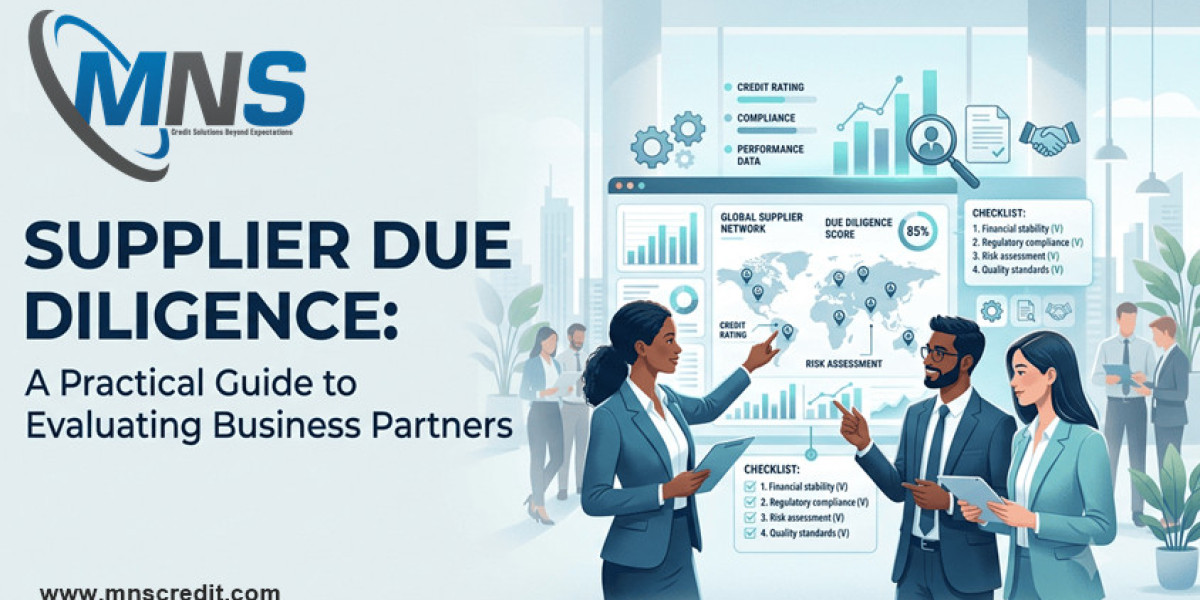

Choosing the wrong supplier rarely announces itself at the start of a relationship. It shows up later — as a missed delivery during a critical order cycle, a sudden insolvency that disrupts production, or a compliance violation that becomes the buyer's problem by association. Supplier due diligence exists precisely to catch these risks before a contract is signed, not after the damage is done. It replaces the assumptions a business makes about a new partner — that the balance sheet is sound, that the ownership is what it appears to be, that the operation can actually deliver at scale — with evidence gathered independently of what the supplier chooses to disclose. This guide walks through what supplier due diligence actually involves, the practical steps to carry it out, and the mistakes that most commonly undermine it.
What Supplier Due Diligence Really Means
Supplier due diligence is the structured process of verifying a potential business partner's legal standing, financial health, operational capability, and compliance record before entering into a commercial relationship. It goes beyond checking a company's website and asking for references — it involves independently verifying claims against government registries, financial data, and regulatory records, so that decisions are based on evidence rather than the supplier's own representations.
The Core Pillars of Supplier Due Diligence
Legal and regulatory standing. This starts with confirming the supplier is a validly registered, active legal entity — checked against MCA21 records for Indian companies, or the equivalent corporate registry for overseas suppliers — along with valid tax registrations and any industry-specific licences the business requires to legally operate.
Financial stability. A supplier's balance sheet strength, liquidity position, credit rating, and payment history indicate whether it can absorb the working capital demands of the contract and continue delivering through economic cycles. Businesses that skip this step often discover financial fragility only when a supplier fails to deliver during a cash crunch.
Operational capability. Does the supplier actually have the production capacity, quality systems, and workforce to fulfil the volumes being discussed? This is verified through site visits, quality certifications, and, where relevant, references from existing customers of comparable scale.
Reputational and compliance risk. Screening for sanctions exposure, adverse media, litigation history, environmental violations, and labour practice concerns protects the buyer from reputational contagion — a growing concern as regulators and customers increasingly hold buyers accountable for their supply chain's conduct.
Contractual and ESG considerations. Increasingly, due diligence also covers a supplier's environmental and social governance practices, particularly for businesses selling into markets or to customers with strict ESG disclosure requirements.
A Step-by-Step Due Diligence Process
Step 1: Define the risk tier. Not every supplier warrants the same depth of scrutiny. Categorise suppliers by contract value, criticality to operations, and geographic risk, and calibrate the diligence effort accordingly.
Step 2: Collect baseline documentation. Request incorporation documents, tax registrations, financial statements, key management details, and relevant licences or certifications.
Step 3: Independently verify the data. Cross-check the supplier's claims against government registries, credit bureaus, and sanctions or PEP databases, rather than relying solely on self-declared information.
Step 4: Assess financial and operational risk. Analyse financial ratios, payment behaviour, and — for critical suppliers — conduct a site visit or virtual assessment of operational capacity.
Step 5: Document findings and assign a risk rating. A clear, evidenced risk rating allows procurement and compliance stakeholders to make an informed go/no-go decision, and creates an audit trail if the relationship is ever questioned later.
Step 6: Build in ongoing monitoring. Due diligence should not end at onboarding — periodic re-screening catches deterioration in a supplier's financial or compliance standing before it becomes a crisis.
Common Mistakes Businesses Make
Many organisations rely too heavily on documents supplied directly by the vendor, without independent verification against registries or credit data. Others apply the same shallow checklist to every supplier regardless of contract size or risk, under-investing in high-value relationships while over-investing in low-risk ones. A further common gap is treating due diligence as a one-time event at onboarding, with no process for re-checking suppliers as their financial position or ownership changes over time.
When to Escalate to Enhanced Due Diligence
Certain circumstances should automatically trigger a deeper level of review: suppliers based in jurisdictions with weaker corporate transparency, suppliers involved in cross-border trade with complex ownership structures, suppliers operating in sectors with elevated fraud or sanctions exposure, and any supplier that will hold a single-source or highly concentrated share of a critical input. In these cases, enhanced due diligence should include deeper beneficial ownership tracing, more frequent financial monitoring, and, where appropriate, an independent site assessment.
Aligning Due Diligence with Contract Negotiation
Due diligence findings are most valuable when they feed directly into contract terms rather than sitting in a separate compliance file. A supplier with a thin liquidity cushion might still be acceptable, but only with shorter payment cycles, performance guarantees, or a cap on order concentration until its financial position strengthens. Similarly, a supplier with a strong operational profile but a gap in environmental certifications might warrant a time-bound remediation clause rather than outright rejection. Treating due diligence as an input to commercial negotiation — rather than a pass/fail gate applied after terms are already agreed — gives procurement and legal teams the leverage to structure a relationship around the actual risk profile of the supplier, instead of accepting it unconditionally or losing a otherwise viable partner over a single flag.
Due Diligence in Multi-Supplier and Distributor Networks
For businesses that operate through distributor or multi-tier supplier networks, due diligence cannot stop at the first-tier relationship. Financial distress, compliance gaps, or ownership conflicts several tiers down the chain can still disrupt supply or create reputational exposure for the buyer, even if the immediate contractual counterparty is sound. Extending a lighter version of the due diligence framework to critical second-tier suppliers — particularly for single-source components or geographically concentrated production — closes a blind spot that many due diligence programs overlook entirely, and one that becomes especially important for businesses managing cross-border distributor relationships across India and the Middle East.
Conclusion
Supplier due diligence is ultimately a discipline of asking for evidence rather than assurances. A business that verifies legal standing, tests financial resilience, confirms operational capability, and screens for compliance risk before signing a contract is far better placed to avoid supply chain disruption, financial loss, and reputational fallout. Building this discipline into a repeatable, risk-tiered process — rather than an ad hoc reaction to a large deal — is what separates businesses that scale their supplier base safely from those that are repeatedly caught out by partners they never really understood.
Partnering with a specialist due diligence provider like MNS Credit Management Group gives businesses access to verified registry data, credit intelligence, and screening capabilities that make this process faster, more consistent, and far more reliable than manual checks alone.